
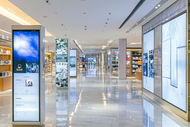
Why Large Signage Increases Visibility And Drives Store Traffic
Published by The Global Display Solution on September 15, 2026, 4:43 am
Quick Summary
Large signage helps priority retail messages stand out from farther away, giving shoppers more time to notice promotions, directions, and featured products. The right signage sizes depend on viewing distance, message length, placement, and the role of each display. There is no single standard signage size for every store, so a layered system should move from large attention-getting signs to smaller shelf-level information.
Retail environments compete for attention at every turn. Products, fixtures, lighting, aisle traffic, and promotional messages can all occupy the same field of view, so important information can disappear into the background. Large signage gives a priority message more visual presence and more time to register, helping shoppers notice promotions, departments, featured products, and directional cues before they reach the immediate display area.
The most effective approach is not simply to make every sign bigger. Signage sizes should match viewing distance, message length, placement, and the role each display plays in the shopper journey. We offer sign holders and poster stands, merchandising displays, price tag moldings, and retail promotional signage that help businesses build that hierarchy from the entrance to the shelf.
How Large Signage Improves Visibility and Supports Store Traffic
1. Start With the Viewing Distance
A sign that needs to be noticed from across a sales floor has a different job from one positioned beside a product. The farther away the viewer is, the more important it becomes to use a clear headline, legible type, strong contrast, and enough scale for the message to stand apart from surrounding visual noise.
There is no single standard signage size that works for every retail environment. A wide grocery aisle, store entrance, lobby, or open promotional zone may call for a larger format, while an aisle end or shelf-level decision point can work better with a smaller sign that carries more detail. The goal is to size the message for the distance at which customers first need to understand it.
2. Use Large Signage for High-Priority Messages
Large signs are most useful when the message deserves immediate attention. Seasonal promotions, department identification, new-product launches, directional information, and major offers can benefit from a display that customers can recognize before they are standing directly beside it.
For entrances and open retail areas, our floor standing sign holders can present posters, notices, promotions, and wayfinding in a format that is easy to see. Placing a high-priority message on a dedicated stand also separates it from smaller shelf labels and product information, making the hierarchy easier for shoppers to understand.
3. Keep Large-Format Messaging Simple
More space does not mean the sign should carry more copy. Large signage works best when the viewer can grasp the primary message quickly. A concise headline, one strong visual, readable typography, and a direct call to action are generally easier to process than a crowded layout. Secondary information can appear closer to the product, where smaller signs can explain pricing, features, or promotion details as the shopper approaches.
4. Build a Signage System From Large to Small
A strong retail signage program works in layers. Large signs can create awareness from a distance, mid-size displays can reinforce the promotion within a department, and shelf-edge signage can deliver the final details near the buying decision. Each size has a specific communication role.
Around case stacks and bulk merchandise, our adjustable pallet sign holders can raise promotional information above tall products so it remains visible. Closer to the shelf, retail promotional signage can highlight discounts, updates, and product information, while price tag moldings with promo grip keep pricing and promotional pieces organized directly where customers are comparing items.
5. Place Signs Where Sightlines Are Clear
Placement can matter as much as sign size. A large poster hidden behind a fixture may have less impact than a smaller sign positioned in a clean line of sight. Entrances, windows, main aisles, aisle intersections, lobbies, and areas beside featured merchandise are common locations where a prominent sign can intercept customer attention.
Consider how people naturally move through the space and the angle from which they will first see the message. A sign should not force customers to stop, turn sharply, or move around an obstruction just to understand it. Matching placement to normal traffic flow gives the display a better opportunity to guide customers toward the next destination or promotion.
6. Use Visual Hierarchy to Reduce Clutter
When every message is presented with the same visual weight, shoppers have to decide for themselves what matters most. A deliberate hierarchy makes that decision easier. The largest format should usually carry the highest-priority message, while supporting signs become progressively more detailed as customers move closer to the product.
Make Large Signage Work Harder for Your Retail Space
Effective large signage combines the right scale with a clear message, appropriate holder, and strategic placement. Rather than searching for one universal standard signage size, plan around viewing distance and the point in the customer journey where each message needs to be understood.
We supply sign holders, merchandising displays, poster stands, shelf-mount sign holders, price tag moldings, and retail promotional signage for grocery stores, facilities, and other retail environments. Our large inventory, strong pricing, and local or overseas manufacturing options allow us to support both small and large orders. Explore our display solutions to build a clearer visual hierarchy from entrance messaging to shelf-level communication.
FAQs
What Is Considered Large Signage in a Retail Store?
Large signage generally means displays designed to be seen from farther away than shelf labels or small counter signs. The right dimensions depend on viewing distance, available space, message length, and placement.
Is There a Standard Signage Size for Retail Stores?
No single standard signage size works for every retail application. Choose the format based on viewing distance, available space, message length, and placement rather than relying on one universal dimension.
Where Should Large Retail Signs Be Placed?
Large signs work best where sightlines are open and customer traffic is strong. Entrances, windows, main aisles, aisle intersections, lobbies, and areas near featured merchandise can all be effective, provided the display is not blocked by fixtures, products, or other visual elements.